Coming Up: Matt Sanderlin at Woodlawn Theatre
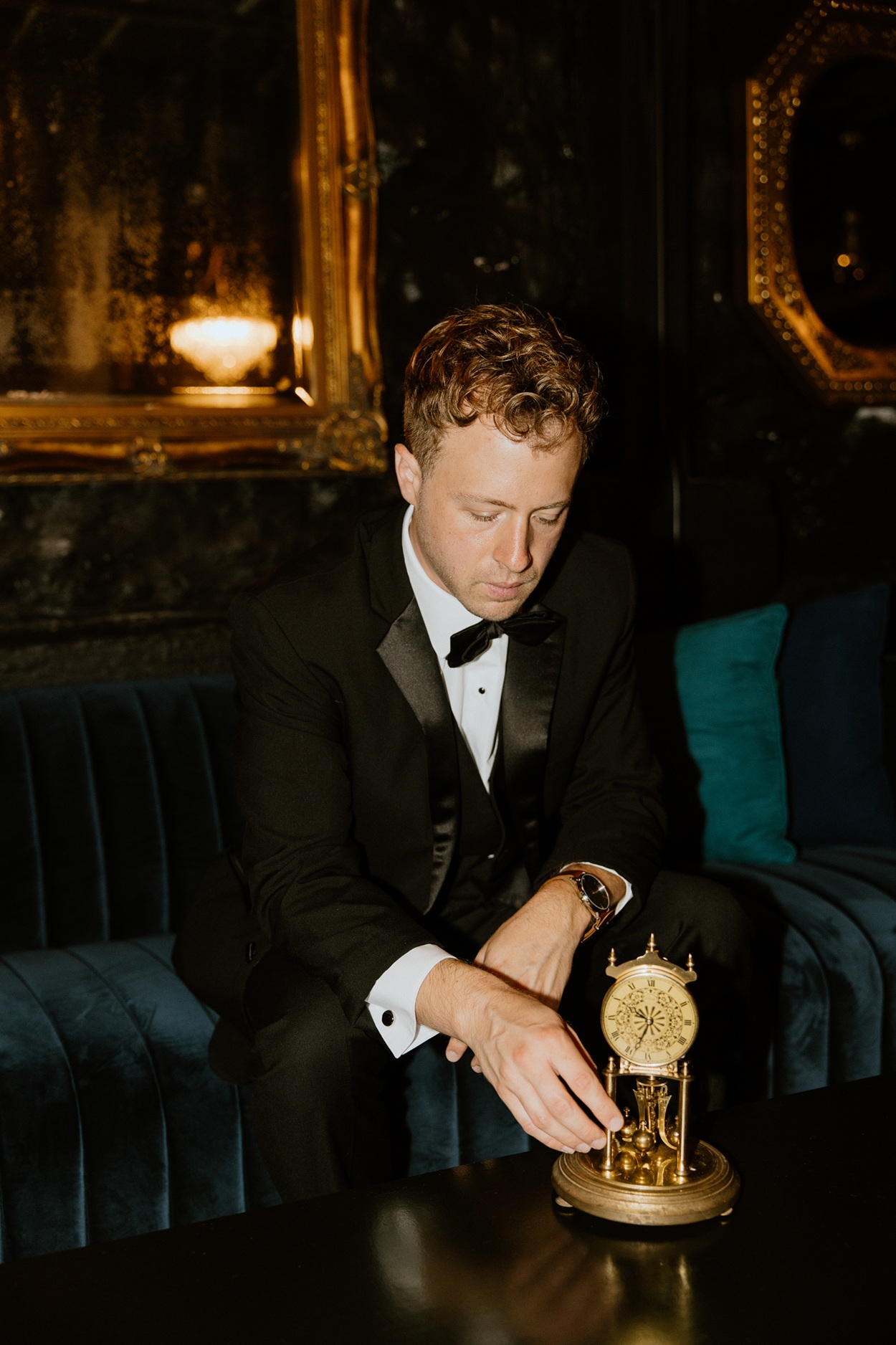
Though he’s spent the last several years fronting dreampop outfit Venture Boi and moving up to Nashville, Birmingham native Matt Sanderlin returns home for a February 7 show at Woodlawn Theatre to present songs from his latest release, a new solo album called Yellow Cocktail Music.
Well, sort of.
While it may be his name on the cover, the album actually sees Sanderlin embodying classic literary character Jay Gatsby, from where else, 1925’s The Great Gatsby by Lost Generation author F. Scott Fitzgerald. In fact, the record is full of other vocalists telling the story of the novel in musical form (Jaxson Deno as Nick, Jessica Coughlin as Daisy, and Joseph Settine as George).
For those who don’t remember their high school English reading assignments, The Great Gatsby is set in 1920s flapper culture, the height of Prohibition, with the Great Depression not too far away. The narrator, Nick Carraway, has moved to New York City and manages to live next to Jay Gatsby in the neighborhood of West Egg. Gatsby’s parties are elaborate and legendary, but Nick notices a desperation in Gatsby despite his constant longing for hope in the green light across the bay. This desperation soon devolves into a heart-wrenching tragedy for all involved.
I spoke with Sanderlin about how he recorded the album, what his green light is, what it was like pressing his first record on vinyl, and why the novel still holds weight after 100 years.
Chris K. Davidson for Magic City Bands: Obviously, everybody reads The Great Gatsby in high school, but you took it a step further.
Matt Sanderlin: I did.
MCB: What was it like the first time you read through it? What stood out to you about the story?
MS: Man, that’s a great question. I remember…honestly, kind of being a bad English student. I was kind of bullheaded, and I only liked to read what I wanted to read. In English class, usually the teacher would go through Animal Farm or Lord of the Flies, or whatever, and I did not have much interest in those books.
But I remember we started the Great Gatsby unit, and I had not read the chapter I was supposed to read, the first chapter. And the teacher started going over it the next day in class. And she was talking about all of this symbolism, and was kind of setting up all the deeper layers of the book, and kind of pointing us in the direction that the story would go. And I immediately, like, sat up, and I was like, man, this is actually kind of interesting.
And so I went home and actually did my homework. I read the first chapter, and I peeked on into the second and third chapter at that point. It was so readable, and the characters were so interesting, Nick is a very interesting narrator, and Daisy is just this iconic, charming character with a lot of layers, and so I was struck by that, and by the time you get to the second or third chapter, I feel like you’re either all in or all out, and I was absolutely sucked in.
MCB: Fast forward 2012 or so when you wrote “West Egg”?
MS: It is. It was my last semester of college. And I was initially living on campus in Montevallo, and the last semester I was there, I commuted from Birmingham. Right as we were approaching that last semester, I had moved all the stuff out of my dorm room. It was the night before I was moving back to Birmingham, and all I had in there was my bed, and I had my MacBook from 2008. And I was just struck with this moment. I think it had a lot to do with going back home to Birmingham, and time passing. All these feelings were stirred up by that, and I felt probably the most like I’ve ever felt like Gatsby in that moment, just kind of thinking about someone that was a kind of a what-if moment that I had had with this person in high school, and it’s definitely inspired me.
So I grabbed my MacBook, and I got on GarageBand and used the really clunky, terrible keyboard on GarageBand just to pound the chords out, and the melody just was kind of a very immediate thing. From there, it transformed into a full song and has had many iterations over the years, several different versions leading up to this album version.
MCB: Your musical journey has taken a few turns since then. What effect did a project like Venture Boi on the album?
MS: Venture Boi has a lot of rules that I keep around it, in terms of writing, and style of lyric, and what instruments are allowed. This was sort of freeing because it was a new set of rules. Still rules, but instead of it being very electronic-based, this album, I wanted to center around very basic, clean electric guitar sounds, and an R&B backbone when it came to the percussion.
I really got into the keys part for “Riders on the Storm” by the Doors. I love that sound. There’s something so dreamy and cinematic about that sound, and I wanted to make sure that was included. So throughout the record, any of the key sounds are created with the Rhodes kind of sound, which is intentional. But it was a new set of rules, and they were different than Venture Boi rules, but they were liberating because it simplified everything so much, down to just the melody and the chords. Is the song good if I play it by myself? Yes, then we keep it. No, then we toss it or set it aside. I kind of boiled everything down to just the essentials.
MCB: When did you decide to recruit this cast of vocalists to play the different characters from the novel?
MS: That happened at the beginning of last year as I was writing everything, I very humorously thought that I should sing all of these characters at first, and there are demos of me trying to emulate a Daisy character or a Nick character, and I worked with a vocal coach through the process. We had a lot of fun playing around with that idea, and it actually helped me find a lot of cool new things about my voice, which is fun.
But as I was listening through the songs and thinking about it from a listener’s perspective, I just thought it’s gonna be really hard for them to figure out what’s going on and who’s singing what. I think it was specifically the song, “What You Ask,” that I knew would be impossible for a listener to understand. It was just one person trying to do a duet with himself, and I was like, that would just be weird.
As soon as I realized this I started looking around for other people who would fit those characters best for those songs.
MCB: Awesome. And, were they all from the Nashville area? Where’d you find them?
MS: Yeah, so the guy who plays Nick is my friend Jaxson Deno, who has played in Venture Boi up here in Nashville, and he’s a little bit younger than me, and I think that sort of youthfulness in his voice really comes through in his songs. He only has two. He’s got the first song, “The Eyes,” and the final song, “Ceaselessly into the Past.” But I think that is sort of how Nick Caraway feels in the book. He comes across young and wide-eyed, and he’s taking a lot of this in, not really knowing much about these parts of life, and so I think that youthfulness comes through in Jaxson’s voice.
And then Jessica Coughlin also is here in Nashville, and she and I have worked together on previous songs, a Venture Boi song and then a solo song that I’ve done, and she just has this really soft, velvety voice. Honestly, there are so many talented vocalists here in Nashville, but I don’t think there was anyone that was a better fit than her, just in terms of what she can convey with the character and with her voice, so she did a phenomenal job.
And then the special guest of the album is Joseph Settine from The Brook and the Bluff, and obviously he’s got Birmingham ties. They’re based here in Nashville, and that was a really special thing to get to do that with him. He’s mega talented, so that was a really special thing.
MCB: The record is very orchestral and reminds me of the shifts you see in Elliot Smith’s work when he goes from Either/Or to XO, and just being able to expand that sonic territory. What was it like to work with those kind of more classical-type instruments?
MS: It was thrilling and terrifying. Truly, I knew I was a little bit out of my depth as I was trying to arrange these things. It’s one thing to know what a brass instrument sounds like or what a string instrument sounds like, and I discovered it is obviously very complex to arrange a part. I did a lot of trial and error just in mapping everything out with software instruments first, and just seeing if it sounded good or made sense.
As I did it more and more, I got more comfortable with it, and I also compared it against a lot of other retro soul R&B music, like Leon Bridges, and tried to find moments and parts of the arrangement that reflected that sound.
That became a really fun exploration for me, and then by the time I actually got to link up with the players, they sort of guided a few things into place and made the parts that I had written into more complex arrangements. That was a really fun, collaborative process, too, but it was really special to see the initial idea, then the evolution of it, and the result for those. It was really fun. It was a little scary.
There’s a really cool clip that I think has been making the rounds of David Bowie in an interview many years ago. I saw it as I was going through this process of learning all this arranging stuff, and it hit home with me. He says something to the effect of you do your best work as an artist when you are a little bit out of your depth, when you’re reaching a little further than you know you can.
And that was exactly what I was feeling in that moment, and it was a huge burst of inspiration when I heard him say that.
MCB: So, going back to the symbolism we find in the book, what would you say your green light is?
MS: My green light has changed over the years, but the most consistent one has always been music and artistry. I think that there are times when it’s felt more or less achievable, just because of where I’m at in different stages of life, but especially leading into this project, it’s almost like the project itself became a green light for me. I saw it as something that was a big, long-time dream, especially the vinyl pressing. Reaching for that was a really fun, challenging and rewarding experience.
Yeah, I think music and artistry sum it up. In the past, again, for “West Egg,” there was a person who kind of reflected that for me, and that was sort of the initial seed of the whole project, but when I got back into it last year and wrote everything, it kind of became its own green light.
MCB: Talk about putting this album on vinyl. What made this the project you were like, okay, we gotta do it?
MS: I have always wanted to press something on vinyl, and I still think it would be fun to go back and press the Venture Boi album, or even some of the Venture Boi singles on vinyl. It had always been talked about by me, and then also with previous bandmates.
This one has such a cool connection to a classic piece of art. Not only did it feel right for that reason because The Great Gatsby‘s been published for 100 years. But also, it felt right because the music business is upside down right now. I really knew that I had done my best work on this record, and I wanted that to be reflected. I didn’t want this to just be an album that people drop in a playlist and forget about it. I really wanted people to get to enjoy it, and hear the layers, and hear the orchestral stuff, and these other talented vocalists and people who contributed to this record.
So it felt like, to me, the best way for anyone to experience that would be on vinyl, and thankfully, it worked out. I was able to do that. It just turned out so nicely.
MCB: And you’ve been able to perform some of the songs in Nashville, right?
MS: I have. I’ve only played one, technically. It was at the Analog. It was for this special event that they do there, and it was really cool. I’ve been wanting to do a full show. It’s obviously a little bit harder to replicate the album live, which has been my one drawback of doing all the crazy, fun, orchestral stuff. How do you do that live? But getting to do it here, it reinvigorated my excitement to play it live, because that song that we played was “In Between Time,” and that song translated very, very well live, and I got so excited hearing it like that.
MCB: And what will the setup be for the Birmingham show?
MS: Yeah, the setup is gonna be super fun. Two bands from Nashville are coming with me for this set. They are super talented. They actually may be closer towards the vein of Venture Boi. They kind of have a dreampop/alternative pop sound. Teddy at Night and Golden Blue, both super talented acts. They’ve been through Birmingham a little bit before. I brought them last time I played with Venture Boi in Birmingham, and so they’re coming along. We also have a full band that’s playing the Yellow Cocktail Music songs.
We’ll have cool guest vocalists, folks who are not on the record, but are gonna do a really cool interpretation of what you hear on the record. There are also some special guests that tie into that original version of “West Egg” that we spoke about earlier, so that’s gonna be really cool to perform that.
MCB: Why did you decide on Woodlawn Theatre for the venue?
MS: All the venues in Birmingham are really cool. Woodlawn Theatre, I’ve never played before.
And it’s been one on my list that I’ve wanted to play for a while, just the historic nature of it. And there’s also a loose Mason Music connection, and I taught at Mason Music for 8 years, so that will be cool to get to work with a Mason Music-related venue. But yeah, primarily, I think it’s just new to me, but also the setting is really fitting for the sound.
MCB: Let’s talk about some of the songs on the record, starting with “In Between Time.”
MS: “In Between Time” is special for a lot of reasons. But one of my favorite things about that song is that it’s in two different keys. Gatsby’s key is how we start the song, so he’s sort of introducing the idea, and sort of romancing Daisy a little bit. And then when she gives her perspective, we move into another key. And by the end of the song, we’ve fallen back down into Gatsby’s key, so it’s kind of a way of showing her joining Gatsby in his dream, in his goal.
So that was really fun to do that. And then, obviously, the orchestral arrangement on that is something I’m really proud of, and I think it turned out really well.
MCB: Talk about “Madman,” which is your swan song because Nick narrates Track 9, so what’s happening in “Madman” for your character?
MS: “Madman” was fun to write. It was also super challenging, because you have three different characters giving their perspectives at the same time, and there’s also a lot of plot I wanted to move forward in that song. So we’ve not heard anything about George Wilson, who is voiced by Joseph Settine. He’s not referenced earlier so much in the album.
And so, to somehow help us figure out who’s singing, and also immediately get us into Gatsby’s psyche and his mindset, and do that within a couple of verses was a challenge, but it was really fun.
A lot of what he sings comes straight off the page, and I think that’s a really fun way to give an homage to the novel. So, he starts, and then Daisy pops in and gives her, sort of, final send-off of the album, and it’s very dismissive of everything, and has some really fun little references peppered in. Like there’s a line where she calls herself a “pretty, little fool,” which is a reference to something she tells Nick in Chapter 2, when she says that that’s the best thing that any girl can be in this world is a pretty, little fool.
And so there are these little elements. Each line has direct ties to the book and to different lines in the book. And then Gatsby meets his end at the end of “Madman,” and that was also kind of a fun way to sum up his story.
I do think that maybe one of the key lines of the album, and probably my favorite line of the whole album, is a Gatsby line at the end of “Madman.” This is not from the novel, but I feel like it’s in such a similar spirit that it feels very connected to it. But the line is “I always thought that love was green, but now it’s become so clear to me, love is blue in endless waves.”
And there’s all of this color symbolism that goes on, right? Like, the green, and the blue, and the red. So, for him to say something like that at the end is a very heartbreaking sentiment, but it also fully embodies his journey and his story. I love that by the end, we’re getting all three of these perspectives at once, singing different lines that are also really closely connected to the book, and it creates this big cacophony of sound, and that was really fun to work on.
There’s one other thing about that song, and I guess it extends to the rest of the album, too.
The main characters in the album each have their own instrument or instrument group that’s connected to them. So, Nick has a French horn, and so on both of his songs, there’s French horn. Daisy has a brass ensemble like a brass quartet, and so when we hear brass quartet, that’s associated with her, and then Gatsby has the strings.
So, in “Madman,” we don’t have French horn, because Nick’s not in that, but we do have brass returning for Daisy, and strings for Gatsby, and that kind of ties into that big, wild moment at the end of the song as well.
MCB: Why do you think The Great Gatsby has had such an iconic legacy of the last 100 years?
MS: I think there are many reasons why Gatsby has endured as a story and as a character.
For me, it’s a very relatable story about someone who loves something so much that he’s willing to sacrifice everything to get to that.
Obviously, there are romantic elements that are attractive, and things like that, but I think the story itself is probably what continues to draw people, because, again, it’s relatable, but it’s very well-constructed. And there are even these little moments that are peppered in with unnamed characters. They really help build the world of it, and tie directly into the theme of the album.
MCB: Why did you decide to release it on vinyl first before streaming?
MS: I love having a physical copy of something, and I think that I forgot how much I love that, because I got used to Apple Music, and the immediacy of finding something, adding it to my library, and then going about my day. But I started to think as I was getting ready to put this album together, and again, thinking about, like, what’s the best way to present this album?
I started going back through my record collection, and I can remember, very specifically, each moment where I bought a record. So if I look at my collection, I can pull a record out and say, oh yeah, I bought this at Seasick Records in Birmingham, or at Pegasus Records in Florence, or, you know, whatever.
And I have to say, when I go through my Apple Music library, it’s not the same. I don’t really remember very much about when I added a column to my library, or even when I listened to it for the first time. Whereas with the vinyl, I feel like I remember a moment where I put headphones on, and I heard Fleet Foxes’ Crack-Up for the first time, or whatever. I think some of it is just the best way to present the album.
MCB: You did some cool stuff to promote the album. Can you elaborate on those?
MS: I definitely went all out on promotion for this album. I found a really cool place in Nashville that has a prohibition/roaring 20s speakeasy vibe, and I did a photo shoot there with my super talented friend Killian Rose. I also read The Great Gatsby in its entirety (one chapter a night) live on Instagram, so people who hadn’t read the book in a while could catch up and be prepared for the album. I also did a big pre-save giveaway and gave away a record player to one lucky person. I really loved sharing my affinity for vinyl with other indie music lovers.
MCB: What are five albums you can listen to from start to finish at any point?
MS: Whitney – Small Talk
Beach House – Teen Dream
Bjork – Post
Radiohead – In Rainbows
Jonathan Ogden – Future Forever
Matt Sanderlin will play Woodlawn Theatre on Saturday, February 7. For more information and to purchase tickets, visit the venue’s website.
Chris K. Davidson is a musician in Birmingham. Photo by Killian Rose.