Coming Up: Lee Bains Album Release at Seasick Records
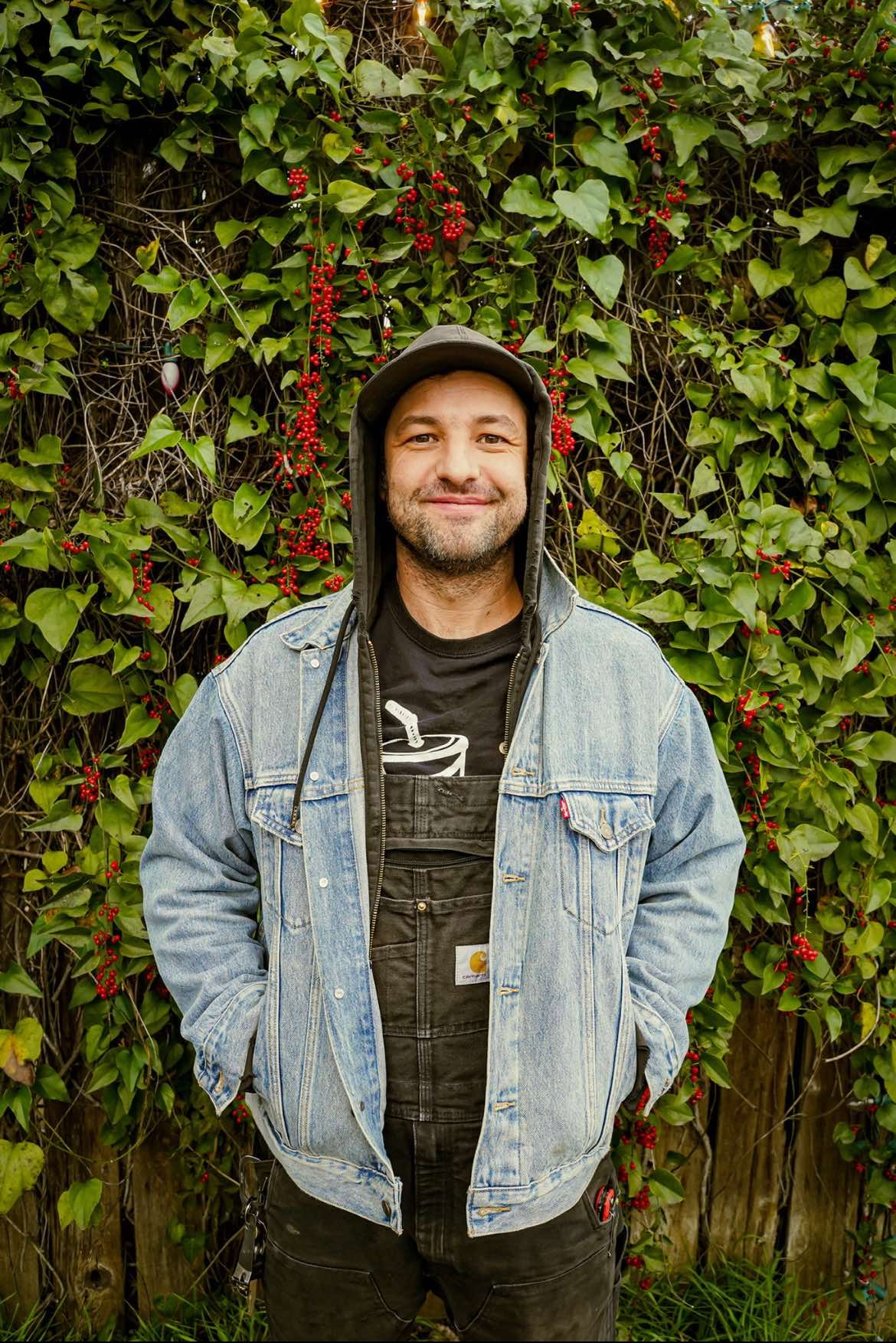
Originally from Birmingham and now living in Atlanta, Lee Bains is an undeniable force to be reckoned with. Cutting his teeth with bands like the Dexateens and his group Lee Bains and the Glory Fires (whose sophomore album came out on the legendary Sub Pop label in Seattle), Bains recently went solo while still maintaining the sheer force and ferocity of his earlier efforts.
Following the release of a book of poetry, he will be releasing an energetic and fiery live album, Free South 2025, that provides the listener with an expansive look into Bains’ catalog from across his career.
We talked about the new album, the parallels between songwriting and poetry, and his thoughts on growing up in the Birmingham music scene.
Chris K. Davidson for Magic City Bands: You have been on Don Giovanni records for several albums. How did that relationship get started?
Lee Bains: I’ve been working with Joe at Don Giovanni for about 10 years now, and am so grateful to say that. Joe is a great guy, and DG is a true independent label of the old type at a time where such labels are endangered. I first found out about DG like most labels I admire, just by listening to albums I love and taking note of who put them out. At that time, DG had put out great albums with bands like Tenement, Screaming Females, Downtown Boys, Nude Beach, Aye Nako (some of whom we’d played with on the road) and, notably, Waxahatchee and PS Eliot, the projects of Birmingham greats Katie and Allison Crutchfield. I had emailed with Joe about his writings on independent music infrastructure before, and when we were looking for a new label in 2016, Katie was kind enough to put in a good word for us as well.
MCB: Have you always been in bands? Or have you always been a solo artist?
LB: I was in my first band in sixth grade (the excellently named Mind Detergent), and probably played my own song by myself for the first time in front of people when I was in the 8th grade. So, I’ve been doing both things for a long time!
MCB: How do you keep the band going when there are so many bands vying for attention?
LB: Well, as of the last few years, I only play my own music solo. The way I keep that going is try to keep my eyes on my own paper and do the best I can at what I do within my limitations.
MCB: How did going to New York University affect your writing?
Well, I had some great literature professors up there who exposed me to literature I’d never read, and encouraged me to ask questions of writing I’d never asked. I read a good bit of English literature from India and Ireland, a lot of 20th-century experimental poetry and fiction, what would be considered classic British literature, and also quite a bit of critical theory. Learning to interrogate texts and what they might be saying about social, political, economic, and philosophical concerns, and how they were saying it on a linguistic level, helped me to see how writing can challenge power structures and how it can be deep and layered in its ways of meaning.
MCB: In addition to this year’s album, you also published a book of poetry [Work Lunch]. What was different about writing poetry? What were the parallels?
LB: I think in a certain way, writing song lyrics for me can be similar to writing certain types of poetry (ironically, similar to older, more formal types of poetry than I typically write when I do write poetry)! A lot of my songs abide by a set rhyme scheme, regular stanzas, etc, as would a lot of English poetry before the 20th century. Like even older forms of poetry, composed when very few people knew how to read, my song lyrics are written to be heard rather than read.
So, when I write poetry, I usually want to do something different. I want to break free of the meter and rhyme that I want to keep when writing song lyrics, and want to avoid the forms and repetitions that I usually want to use when writing song lyrics.
MCB: What style of poetry do you enjoy writing?
LB: I’m not sure how I would classify its style! I’d say that I usually most enjoy writing in free verse. In this book, I really enjoyed the notion of objectivist poetry, where the letters and words and sentences and stanzas on the page are signifying, Not just as language, but also as a constructed, visual object.
MCB: How did this new album get started?
LB: After playing with a band for many years, I shifted my focus to playing by myself in 2024. I’d been experimenting with programmed drums and synthesizers for a while, and started making drum and bass beats. After doing a few tours playing my songs in this way, I thought it would be cool to document this new sound. I also wanted to document the sets I was playing—largely comprised of songs that speak in opposition to Trumpism, economic exploitation, racism, sexism, homophobia, militarism, imperialism, classism, polarization, and so many other -ism’s we’re all struggling with right now. Joe at Don Giovanni thought it was a good idea, too, and we decided to do it at Cherry Street Tavern, a great venue run by my longtime friend and great musician Marty Bohannon, in Chattanooga, a town and scene that has always felt like a second home.
MCB: What were the first songs you wrote?
Since this is a live album, all of the songs had been written and released on other albums years before. The oldest song on the live album is “The Company Man.” I would’ve written that song in 2012 or 2013.
MCB: Where did you record?
LB: Matt Bohannon recorded the shows at Cherry Street Tavern in Chattanooga, Tennessee. Jamie Sego did a heroic job mixing the album up in the Shoals at Portside Sound. It was mastered by Carl Saff up in Chicago.
MCB: What is your favorite song and your favorite lyric from the album?
LB: I don’t have any kids, but I’ve heard from people who do that parents don’t have favorite kids. That’s how I feel about my songs.
MCB: What made you decide to release the album at Seasick and play your first show of the tour at Seasick?
LB: Being that Birmingham will always be home (even though I’ve gotten my mail in Atlanta for a long time now), I always like to release things there. Seasick has been such a great store and hub for the city since it opened, and they’ve always been cool to me and my albums. They are a shining example of an independent, community-oriented record store at a time where such places are harder to find than they used to be. so Joe and I figured, what better place to do an album-release show?
MCB: How do you see the Birmingham music scene now as opposed to when you first got started?
LB: That’s a great question! And one whose answer is going to be significantly colored by two facts: One, that I started as a teenager (about 25 years ago!), and that I’m now middle-aged; and two, that I’ve lived in Atlanta for the last 15 years. so take this with a grain of salt!
I think there are a few continuities. One is that, at least in the indie/DIY scene, Birmingham was never a single-sound town. Some cities like Athens, Georgia or Chapel Hill, North Carolina had a sound associated with them that they were known for. Same with Memphis or New Orleans. In Birmingham, each band or person or little clique did their own thing musically. It was very common to go to a show at Cave 9 and see four artists/bands that sounded nothing like one another. I always loved that, and I think it’s a real strength for an arts community. It’s a great example of unity in diversity, and of the power inherent in people encouraging one another to be themselves.
I think the largest difference I’ve seen is that, when I was a teenager and in my early 20s, the sizable majority of the people you’d be around in the music scene were from central Alabama. like, most people were from spitting distance of Birmingham or 459, and pretty much everybody was from between let’s say, Gadsden and Tuscaloosa, Sylacauga and Winfield, Anniston and Fayette, Clanton and Cullman. This has seemed to change a lot. From what I can tell, young people are moving to Birmingham from further-flung parts of the state, region, or even the country. That was a pretty rare thing to see in the 2000s.
MCB: What are five albums you can listen to from start to finish at any point?
LB: The Clash – Give ‘Em Enough Rope
The Verve – Urban Hymns
Outkast – Aquemini
Kym Register + Meltdown Rodeo – Self-titled
Miles Davis – In a Silent Way
MCB: What formats will the album be?
LB: It will be on vinyl, downloadable files, and streaming. No CD or cassette for this one (or at least not yet!).
Lee Bains will kick off his upcoming tour with a vinyl release show at Seasick Records on Friday, August 7, at 6 p.m.
Photo by Chad Cochran. Chris K. Davidson is a writer and musician in Birmingham.